Digital Logic Design Lab
Role: Instructor.
Institute: Habib University
Offered in: Fall 2018, Spring 2019
About:
This lab introduces the principle and application of digital devices and systems. Digital Logic Design Laboratory helps students to understand Digital Circuits Analysis. The lab learning process is centered on building these circuits from discrete components and analyzing them. The lab provides the opportunity to design digital circuits using the hardware description language and verify their behavior using computerized circuit simulation methods. Verilog the principle for the design of combinational and sequential digital circuits implemented by using Xilinx Field Programmable Gate Array (FPGA) .The lab learning process is centered on the design flow procedures of (a) design entry, (b) synthesis and Implementation of the design, (c) functional simulation and (d) testing and verification.
I, being the lead instructor, redesigned the lab components from scratch in Fall 2019 at Habib University. I also developed two softwares to help students perform laboratory experimentation interactively. Both the tools can be downloaded from the link given below.
About DLD Lab EdTech Software Tools
During my tenure at Habib University, I taught the course “Computer Architecture (CA)” first and then in later I taught the course “Digital Logic and Design (DLD)”. While teaching CA, I realized that students are weak at Number Systems, and they should have spent enough time on it while taking DLD course. Therefore, when I was given the task of redesigning DLD, I planned to enforce students to practice more with number systems. I also decided to include the concept of Number Systems in the lab.
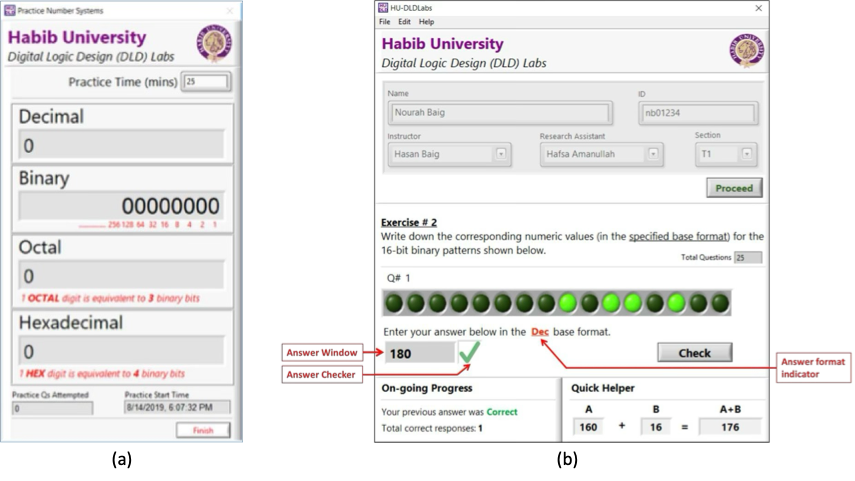
To give students a “flavor” of “experimenting” with the Number Systems, I developed a software which:
- First, enforce students to practice with Number Systems, at least for 25 minutes (this setting could be changed with instructor credentials). The number of questions students attempt are recorded and can be verified by instructors or lab assistants (Figure B1(a)).
- Next the students are given interactive exercises, which generates the questions randomly and verify the answer provided by students (Figure B1(b)).
- In the end, software also generates a PDF report containing all the questions attempted by student with their answers labelled as “correct” or “wrong”.